Choosing Everyday Dinnerware That Lasts
How to choose everyday plates and bowls by material, size and stackability, with the honest trade-offs between stoneware, porcelain, bone china and melamine.
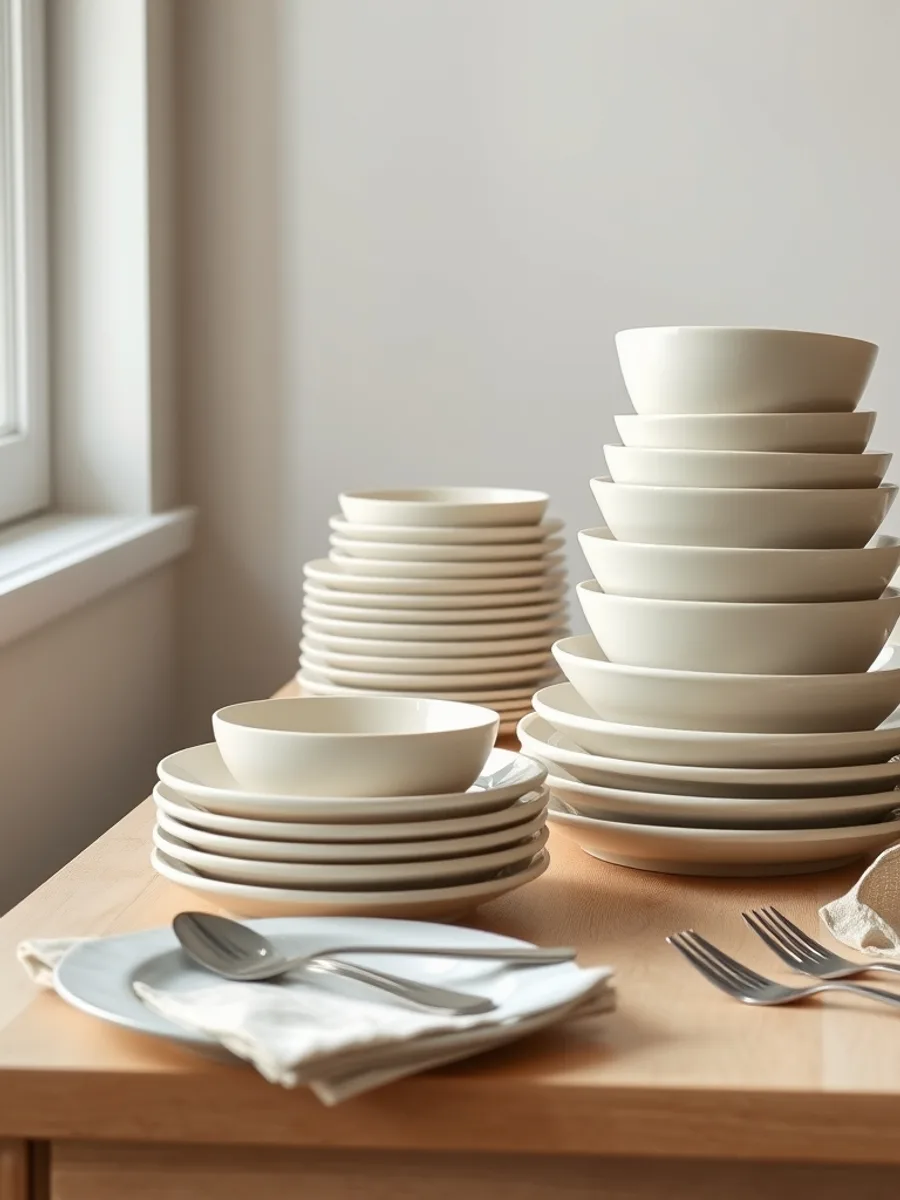
Everyday plates take more punishment than any other thing in a kitchen: three meals a day, a dishwasher cycle, a stack that gets taller every time the cabinet is reloaded. Most sets fail not because they were cheap but because they were bought for the wrong reasons — a pattern, a sale, a photograph. Choosing well comes down to four things you can judge in the store.
This post contains affiliate links. If you buy through them, we may earn a commission at no extra cost to you. Read our Affiliate Disclosure.
Start with the size of the plate, not the pattern
Dinner plates sold in the US commonly run from 10 to 11 inches across, and that inch matters more than it sounds. An 11-inch plate piled with food looks mean; a 10-inch plate with the same portion looks generous, and it fits a standard dishwasher row without tilting. For most households, 10 to 10.5 inches is the sensible everyday size, with a salad plate around 8 inches.
Bowls are less standardized and more personal. A wide, shallow bowl of 8 to 9 inches across holds pasta and grain bowls without the food climbing the sides. A deeper 6-inch bowl is better for cereal and soup. If you buy a boxed set, check the bowl dimensions before you commit, because a set with four deep cereal bowls and no shallow ones will leave you serving dinner in pasta plates.
Weight is the other physical cue. Pick up a plate and hold it at the rim with one hand. If it flexes, it will chip at the edge within a year of ordinary stacking. If it is uncomfortably heavy, clearing the table becomes a chore and the plates will chip the sink instead.
Materials, honestly compared
| Product | Best for | What to know |
|---|---|---|
| Glazed stoneware | Daily family use, casual hosting | Heavy and chip-resistant, but often bulky to stack and some pieces are not oven-safe |
| Porcelain | Everyday use where weight matters | Denser and lighter than stoneware, usually more chip-prone at thin rims, widely dishwasher-safe |
| Bone china | Lighter everyday sets and tea | Thin, light and strong for its weight, but expensive to replace and rarely tolerant of oven heat |
| Earthenware | Color, texture, slow meals | Warm and inexpensive, but softer glaze crazes and it generally should not go in the dishwasher |
| Melamine | Outdoor meals, households with small children | Light and near-unbreakable, but not for microwave or oven, and it scratches over time |
Two specifications are worth checking on the box rather than guessing: whether each piece is marked dishwasher-safe, and whether it is marked microwave and oven-safe. Those claims come from the manufacturer, and they vary within the same range, so read them per item. "Dishwasher-safe" on a box does not always mean the same thing as "oven-safe to 350°F".
Read the rim
A rim is where most everyday damage starts. A flat rim with a slight lip is the most durable shape and stacks securely. A very thin, sharply tapered rim looks elegant and chips at the first knock. A rolled rim on a bowl is stronger than a cut edge, which is why inexpensive bowls with rolled rims often outlast expensive ones with cut edges.
Look, too, at the foot ring underneath. A deep foot ring that sits inside the base of the plate below it stacks with less lateral movement. A flat base with no foot ring slides, and a sliding stack is a chipped stack.
Set or open stock
Boxed sets are cheaper per piece and instantly coherent. They are also inflexible: you get the bowl you did not want, and when one plate breaks you cannot buy a replacement.
Open stock — buying plates and bowls individually, usually in quantities of four or six — costs more up front and pays back over a decade. If a piece chips, you replace one item. If your household changes, you add two more settings rather than a whole service for eight. We would only choose a set if the pattern is a long-running line the maker still produces, which is worth asking about directly.
For most people the practical middle is a set in a plain glaze from a line that has been sold for years, then topping up later with open stock. Plain cream, white and warm gray are the safest; strong colors and hand-painted patterns are the first to be discontinued.
Care that actually extends life
Stack plates with a napkin or felt pad between them if the glaze is matte, because matte glazes mark against each other. Do not stack bowls inside each other with force; the foot of the top bowl is what chips the rim of the one below. Wash promptly after acidic food, since tomato and vinegar can dull a soft glaze over time, and skip the dishwasher's heated dry cycle for anything hand-painted.
Chipping is cumulative and mostly happens at the sink, not at the table. A rubber mat in the bottom of the sink and a dish rack that holds plates upright rather than leaning them against each other will save more pieces than any careful handling at dinner.
If you are setting the table often, our guide to casual hosting covers how many settings are actually useful, and counter organization explains where to keep the overflow without stacking it on the work surface.
What to buy first
A plain stoneware dinnerware set of four is the lowest-risk starting point for a household that eats at home most nights. If weight is the deciding factor, look at porcelain dinner plates sold as open stock. Add wide shallow pasta bowls before you add more plates, since they cover more meals than a second dinner plate does. For outdoor eating or a household with toddlers, melamine plates in a matte finish are the practical choice, provided you never put them in the microwave.
FAQ
Is stoneware or porcelain better for everyday use?
Stoneware is heavier and generally more chip-resistant, which suits households that stack roughly and wash by hand. Porcelain is lighter and denser, easier to stack in quantity, and usually fine in a dishwasher, but thin rims chip more easily. Neither is better in the abstract; pick by weight tolerance and how carefully your dishes are handled.
How many place settings does a household of four need?
Eight is the usual answer, because it covers guests and the inevitable breakage without storing a second set. If space is tight, six settings plus a few extra plates is more useful than eight of everything, since plates get reused for serving far more often than bowls do.
Why do my plates chip at the edge?
Almost always from stacking and sink contact rather than from cutting. Plates that slide against each other, or lean against a metal rack, chip at the rim over months. Felt pads between matte-glazed plates and a rubber sink mat remove most of the cause for very little money.