Outdoor String Lights: How to Choose and Hang Them
Outdoor string lights fail at the connection, not the bulb. Match the run to the circuit, pick waterproof fittings, and give the wire something solid to pull against.
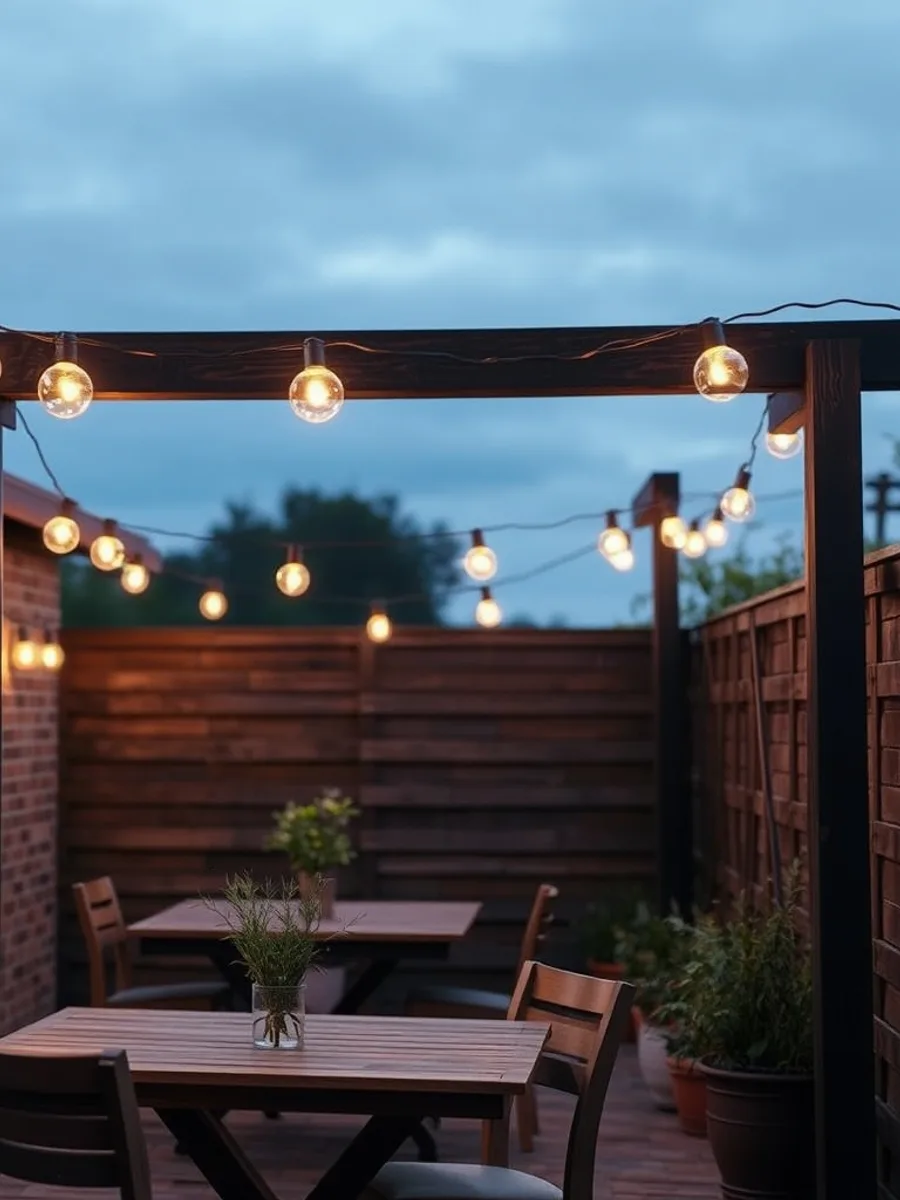
Outdoor string lights rarely fail because of the bulbs. They fail at the connection, the transformer, or the anchor that pulled out of a brick wall in the first storm. Choosing them well is mostly a question of arithmetic and hardware, which is less romantic than the photographs but considerably more useful.
This post contains affiliate links. If you buy through them, we may earn a commission at no extra cost to you. Read our Affiliate Disclosure.
Start with the circuit, not the bulbs
Every string light set has a maximum run length, usually printed on the cord or in the specification, and every household circuit has a limit too. A standard US outdoor receptacle on a 15-amp circuit can carry about 1,800 watts, but that circuit is often shared with a garage, a bathroom, or the kitchen. Add up the wattage of everything you plan to plug in and stay well below the total.
The safer approach is to count bulbs rather than guess. A 48-foot strand with 24 LED bulbs at 1 watt each draws about 24 watts, which is trivial. The same strand with incandescent bulbs at 7 watts each draws close to 170 watts and runs much hotter. LED sets cost more and use a fraction of the power; for a run you intend to leave up all season, they are the sensible choice.
Check whether the set is rated for outdoor use and whether it can be connected end to end. Most can, up to a stated number of strands. Exceeding that number is the most common cause of a dead run in the middle of a party.
Voltage changes the whole installation
Plug-in 120-volt sets are simple: one cord, one outlet, no transformer. They are also limited in length and heavier per foot. Low-voltage 12-volt sets use a transformer that steps the power down and lets you run longer distances with thinner cable, which is why they are common on pergolas and along fences. The trade-off is the transformer itself, which needs a dry, ventilated spot and is the part most likely to fail.
If you want dimming, decide before you buy: some LED sets dim with a remote and a compatible driver, while others flicker below a certain level.
Bulbs, spacing, and the look
Two shapes dominate: the S14, a small Edison-style bulb with a visible filament, and the G40, a round globe. Both are usually available in warm white around 2700K, which reads as incandescent rather than clinical. Anything above 3000K starts to look like a parking lot.
Spacing determines whether the lights read as a garland or a string of dots. Eighteen to 24 inches between bulbs is the usual range for a pergola or a patio span. Closer looks dense and festive; wider looks sparse and can leave dark gaps over a table.
Height matters more than most people expect. Hang the lowest point of the swag about 7 to 8 feet above the floor so nobody walks into it, and keep bulbs at least two feet from anything flammable. Over a dining table, 6.5 to 7 feet at the lowest point is comfortable and still clears heads.
Give the wire something to pull against
String lights are under tension, and tension is what pulls anchors out. The reliable method is a galvanised wire cable stretched between two solid points, with the light strand zip-tied to it. The cable takes the load; the lights just hang.
For posts, use screw-in eye hooks in treated timber or stainless anchors in masonry. Avoid anchoring into the face of a brick or a mortar joint, which crumbles under load; go into the timber sill or use a through-bolt. Keep spans under about 20 feet between supports, and add a turnbuckle so you can tension the cable after it stretches.
Never hang lights from a gutter, a downpipe, or a fence panel that moves in wind. If you need a point in the middle of a patio, a pair of weighted string light poles solves it without drilling.
| Product | Best for | What to know |
|---|---|---|
| 48-foot S14 LED strand | Pergolas and patio spans | Check the maximum connected run; measure before ordering |
| Low-voltage globe set with transformer | Fences and long runs | Transformer needs a dry, ventilated location |
| Weighted string light poles | Rentals and open patios | Fill the bases with sand or water; check the wind rating |
| Galvanised wire and turnbuckle kit | Any span over 12 feet | The cable carries the load; zip-tie the lights to it |
| Outdoor-rated extension cord | Reaching a distant outlet | Match the gauge to the length; keep connections off the ground |
For a typical patio, a 48-foot S14 LED string light strand covers a 12-by-12 area with a little slack, and a low-voltage globe set with a transformer suits a longer fence line. Weighted string light poles solve the rental problem, and a galvanised wire kit with a turnbuckle keeps a long span from sagging into the table.
Weather, water, and the details that matter
Look for a stated IP rating. IP44 is splash-resistant and adequate under a porch roof; IP65 is better for exposed positions. The weak points are plug connections, so wrap them or use a box designed for outdoor use, and keep every connection above ground and out of puddles.
Plug into a GFCI-protected outlet. That is not optional outdoors, and it is the single most effective safety measure in the whole installation. If the outlet is not GFCI, have one installed or use a portable GFCI adapter.
Taking them down
At the end of the season, take the lights down if they are not rated for year-round exposure, and coil them loosely rather than wrapping the strand around your elbow, which breaks the internal wire. If they stay up, check the anchors in spring. For the furniture underneath, our guide to patio furniture care covers the same seasonal logic, and balcony garden basics explains how to light a small space without drilling into the building. For the wider lighting plan, see layered lighting basics.
FAQ
How many string lights do I need for a 12-by-12 patio?
Plan for 48 to 60 feet of strand to cross a 12-by-12 area in two or three shallow swags, plus slack to reach the outlet. Measure the path rather than the room; a diagonal run is longer than it looks.
Can I leave outdoor string lights up all winter?
Only if the set is rated for it and the connections stay dry. Cold makes PVC cord brittle, and wind load on a frozen strand can pull anchors. Many people leave the wire cable up and take the light strand down, which is the easier compromise.
Do outdoor string lights use a lot of electricity?
LED sets use very little: a 48-foot strand is typically under 30 watts, comparable to a single old light bulb. Incandescent sets can draw several hundred watts for the same length, which matters if the lights stay on for six hours a night.